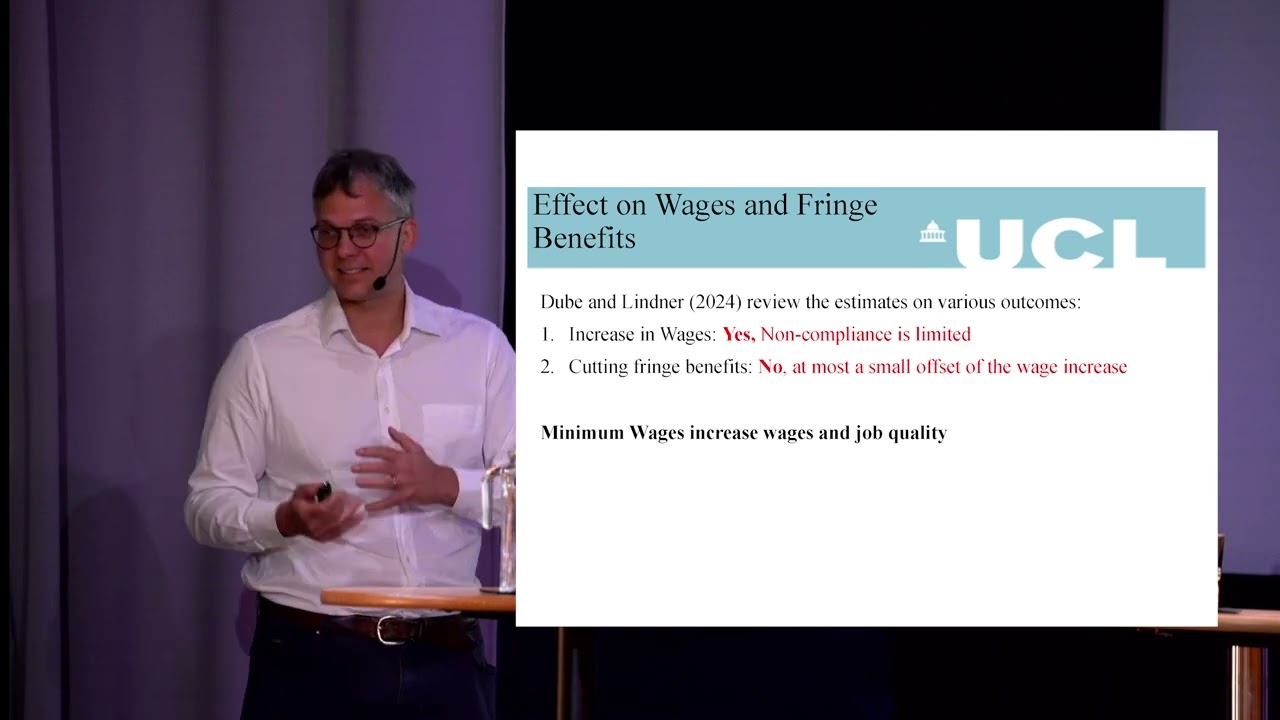
This seminar was filmed during the conference "Modern labour markets Trade unions, social dialogue and productivity" 3 June 2025 in Stockholm, Sweden. During the twentieth century, almost all academic economists were highly sceptical about minimum wages. The reason for this was that conventional theory showed that increased minimum wages could not lead to anything else than reduced employment. Therefore, at the level of the individual firm a rise in the minimum wage would only lead to a proportional reduction in the number of employees. Nothing is gained. However, the modern, empirically oriented labour market research has over the last decades shown that the correlation between minimum wages and employment is more complicated than what was previously assumed. Consequently, several countries have introduced minimum wages, and they have been substantially increased in many countries that already have it. Behind this development, there are broad-based intellectual and scientific steps forward. Attila Lindner, is a professor of economics at University College London. He is an internationally well-known researcher on how minimum wages affect employment, productivity and other variables. Last autumn, he gave a keynote speech about this research at the yearly conference of the organization for European labour economists. Presentation: Attila Lindner, Professor at the University College London. Panel: Attila Lindner, Professor at the University College London. Thomas Carlén, Economist at the The Swedish Trade Union Confederation (LO). Charlotta Stern, Professor, CEO Ratio. Merja Kauhanen, Chief Researcher, Labore. Moderator: Daniel Lind, Head of Research, The productivity Commission of The Swedish Unions within Industry.
Källinformation
- Utgivare:
- YouTube
Skapad: 30 april 2026